AI Is Speeding Up Decisions. Can You Still Verify the Conversation Behind Them?
When an AI-assisted outcome is questioned, the original recording preserves what was actually said, becoming the ultimate source of truth.
Let me start with 2 observations and a preliminary conclusion. First, the use of AI in the enterprise has gone beyond automation and is now firmly in use at the decision-making level. Second, those who fully embrace agentic automation are automating more processes than they can manually check in a day – checking all of your agents’ homework is no longer possible. The conclusion, based on the universal human truth that we are “control-seeking beings,” is that to both stay sane and to ensure we can check our homework if needed, we need a final single source of truth, a backstop to the fire hose of decisions being made, even if there aren’t enough hours in the day to check every decision.
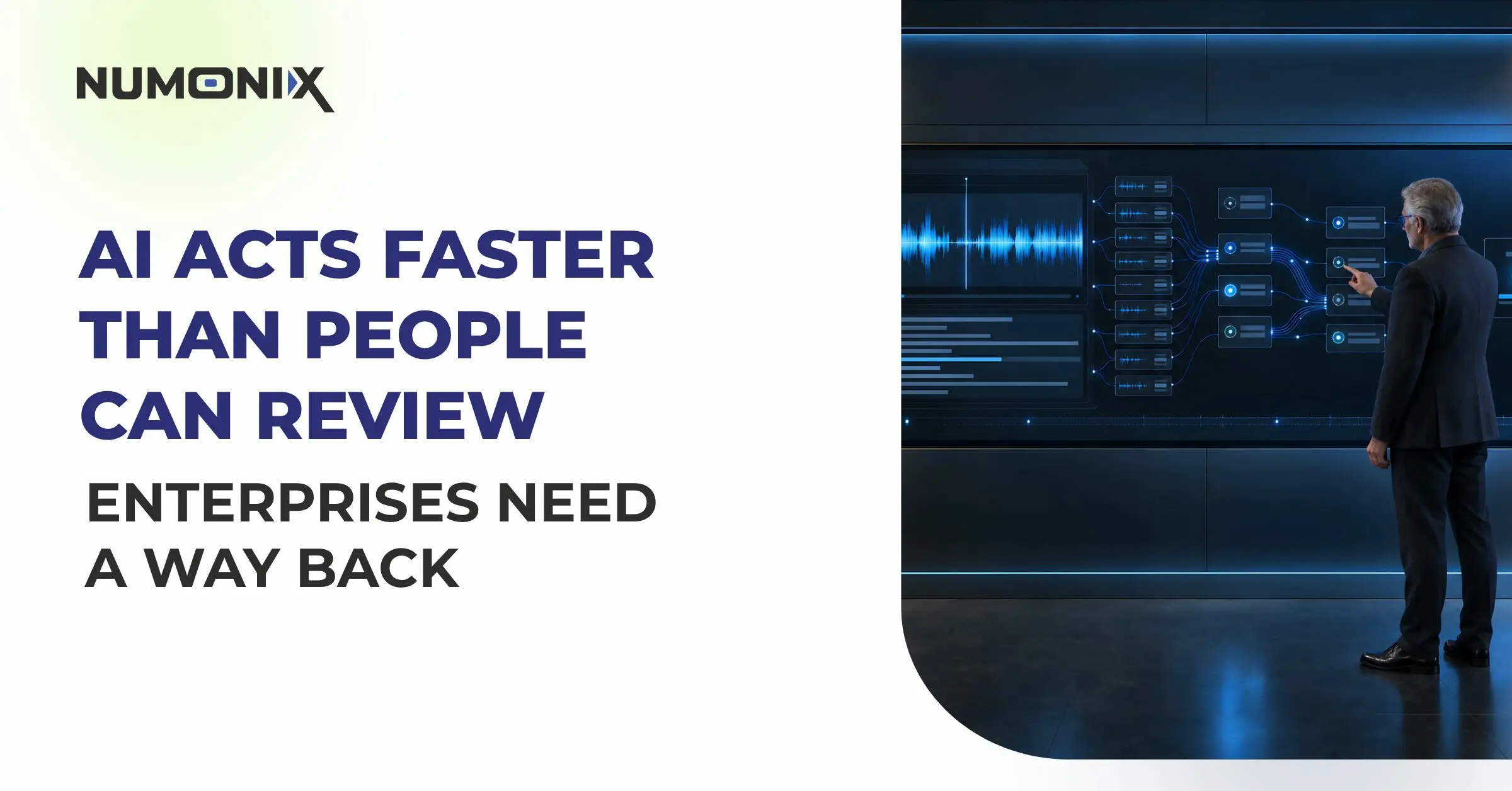
The distance between receiving information and acting on it is shrinking, while human review still has to move at human speed.
Let’s build a reasonable example. A meeting takes place, and an AI generated summary is attached to the transcript. Perhaps additional meetings take place on the same subject in the course of a project, with similar outputs and artifacts being generated. An agent then retrieves information from all of these disparate sources and recommends an action. By the time someone actually questions how a decision was reached, it’s entirely likely that everyone has lost sight of the original content of the actual call.
Complete model explainability is the wrong standard
It is seductive to frame this problem as a requirement that we have complete AI explainability. If an organization could see every internal reasoning step, the argument goes, it could simply reconstruct why the system produced a particular result. The problem, as we’ve discussed recently, is that this is becoming increasingly impossible.
Recent model research complicates that expectation. In a September 9 update to the GPT-6 Astra System Card, OpenAI reported monitorability limitations in some of its testing.
Enterprises need something more tangible than this if they’re to have some sense of control over their internal audit process. And this all comes down to ensuring that they’re preserving the actual evidence surrounding what the AI system used to make the decision even when they cannot reproduce everything that happened once the transcript entered the machine.
The evidence includes everything that was fed into the application – the identity and permissions under which it operated, the instructions or rules applied, any human approval, and the action or output that followed. The goal is to be able to do proper due diligence around the consequential activity that drove a decision – using tangible evidence the organization can control, namely the actual call recording.
Investigations work backward
An AI-governance program usually begins by asking what a system should be allowed to do. An investigation begins from the other end.
The investigator starts with the outcome and works backward. Which output influenced the decision? Which agent or application produced it? What information did the system retrieve? What did the original communication contain? Who had access to that record, and was it preserved under the appropriate policy?
Microsoft Teams Facilitator illustrates the problem inside business communications. UC Today reported that Facilitator can identify an unresolved question during a meeting, retrieve information, and introduce an answer into the live discussion. A recording can preserve the question, the answer, and the conversation that follows.
Thus, the recording is essential. It sets in stone what actually was said in the interaction, even when additional evidence is needed to understand how the AI arrived there.
Reconstruction requires two evidence layers
A dependable reconstruction requires two distinct but connected evidence layers.
The first is the governed communication source. This includes the original call or meeting recording, the transcript, the participant and timing information, and all the standard compliance call recording foundations. The second is AI action evidence. This is what establishes which agent did what.
The major AI platforms are beginning to reflect this requirement. OpenAI’s persistent-agent model includes dedicated identities, permissions, approval requirements, and activity views. Microsoft has similarly linked governed business context with agent observability and pre-approved actions.
These two layers are entirely complementary and totally interdependent. The ability to reconstruct a decision depends on continuity between them.
The importance of the source recording as AI-generated work moves downstream
Everything AI does in a decision-support scenario happens between the conversation and the work that follows. If we follow the proverbial bouncing ball, once a recorded interaction takes place, it becomes a transcript. The transcript becomes a summary. The summary produces a task. Someone enters part of the task into a CRM record, and another employee acts on that compressed version without hearing the original exchange.
Like an enterprise version of “playing telephone,” the chain of summarizations can (not always!) start to remove qualifications, uncertainty, or context. The artifact furthest from the conversation may carry the most weight because it appears where the next employee is working. The organization eventually discovers the problem when someone needs to travel in the opposite direction, from the task back through the summary and transcript to what the participants actually said.
The point is not to return to the parchment and abacus level need to replay every call – let’s acknowledge the value of summaries and recommended actions, because they are necessary in this day and age precisely because we can’t continually return to every source interaction. The point is that when we have to backtrack to understand something, we need to know the way back – all the way to the original call.
Where IXCloud fits
This is what IXCloud gives us in this scenario. Its policy-based capture, search, controlled playback, permissions, retention profiles, legal hold, audit records, controlled sharing, and recording-integrity validation help an authorized reviewer locate the relevant interaction in seconds, examine it, understand its governance history, and potentially preserve it when normal deletion must be interrupted.
These capabilities can support audit defensibility and evidentiary integrity. Again, this isn’t the AI agent-action layer. IXCloud just handles the call capture, secure transmission and storage, and the fully compliance-caliber governance of who can access it.
That boundary matters. A communications system of record and an AI platform answer different investigative questions. Organizations need to determine how evidence from the two environments will remain connected when an AI-assisted workflow becomes consequential.
Run one workflow backward
Compliance and IT teams can test that connection without building an abstract enterprise-wide framework. Select one significant AI-assisted communications workflow and start with its outcome.
Go identify the original call, check to see if the recording is still available under the relevant retention policy, and find out if an authorized reviewer can retrieve and play it. Figure out if the recording, transcript, summary, and downstream actions are all connected. Now, the enterprise needs to figure out whether it can identify the agent or system that participated, what it did, and be able to provide its identity, retrieval, approval, and activity records.
One platform doesn’t supply every answer. The practical test is whether the evidence is preserved and retrievable.
What humans need in an age of AI automation
AI can accelerate work without making every decision fully explainable. When an outcome is challenged, trust depends partly on recourse: an authorized person needs a practical way to examine what happened and return to the authoritative evidence outside the model.
We are control-seeking beings – we strive to make as much sense of the world as we can, we desperately need closure, and we are actively seeking control over our lives in an increasingly out-of-control world. Ensuring we firmly have a foundation in place that serves as the ultimate source of truth gives us that sense of closure, even if the AI model we shoot it through makes it difficult to fully comprehend.
But what we can’t fully follow, we can always reconstruct.
Frequently Asked Questions
What is reconstructable evidence in an AI-assisted workflow?
Reconstructable evidence is the collection of records needed to examine a consequential AI-assisted outcome after it occurs. It may include the original communication, transcript and metadata, along with separate AI-platform records covering identity, retrieval, instructions, approvals, outputs, and actions.
Can a call or meeting recording explain why an AI agent made a decision?
No. A recording can establish what was said during the interaction and how participants responded. It does not necessarily reveal every source the agent consulted, the instructions it received, or why the underlying model produced a particular answer.
What is the difference between a communication record and an AI activity log?
A communication record preserves the interaction between the participants, including what people or AI participants said. An AI activity log should document the automated system’s identity, permissions, retrievals, approvals, outputs, and actions. Both may be needed to reconstruct a consequential workflow.
Why preserve the original recording when a transcript or AI summary already exists?
Transcripts and summaries make communications easier to search and use, but each transformation can remove context or qualification. Preserving the original recording gives an authorized reviewer a source against which derivative artifacts can be examined when an issue, dispute, or investigation arises.
What evidence should an organization retain when AI participates in a Microsoft Teams meeting?
The appropriate evidence depends on the organization, use case, policies, and applicable requirements. A reconstructability review may consider the governed recording and transcript, participant and timing metadata, access and retention history, and separate platform evidence showing the AI participant’s identity, sources, approvals, and actions.
How does IXCloud support investigation of an AI-assisted communication?
IXCloud can support the communication-source portion of an investigation through policy-based capture, search, controlled playback, permissions, retention, legal hold, audit records, secure sharing, and integrity validation. It does not replace the identity, retrieval, approval, and activity records that should come from the AI platform.
Does every AI-assisted business conversation need to be recorded?
No. Recording scope depends on the organization, activity, participants, jurisdiction, purpose, and applicable policies or regulations. Organizations remain responsible for deciding which communications should be captured and how those records should be retained, accessed, reviewed, and produced.