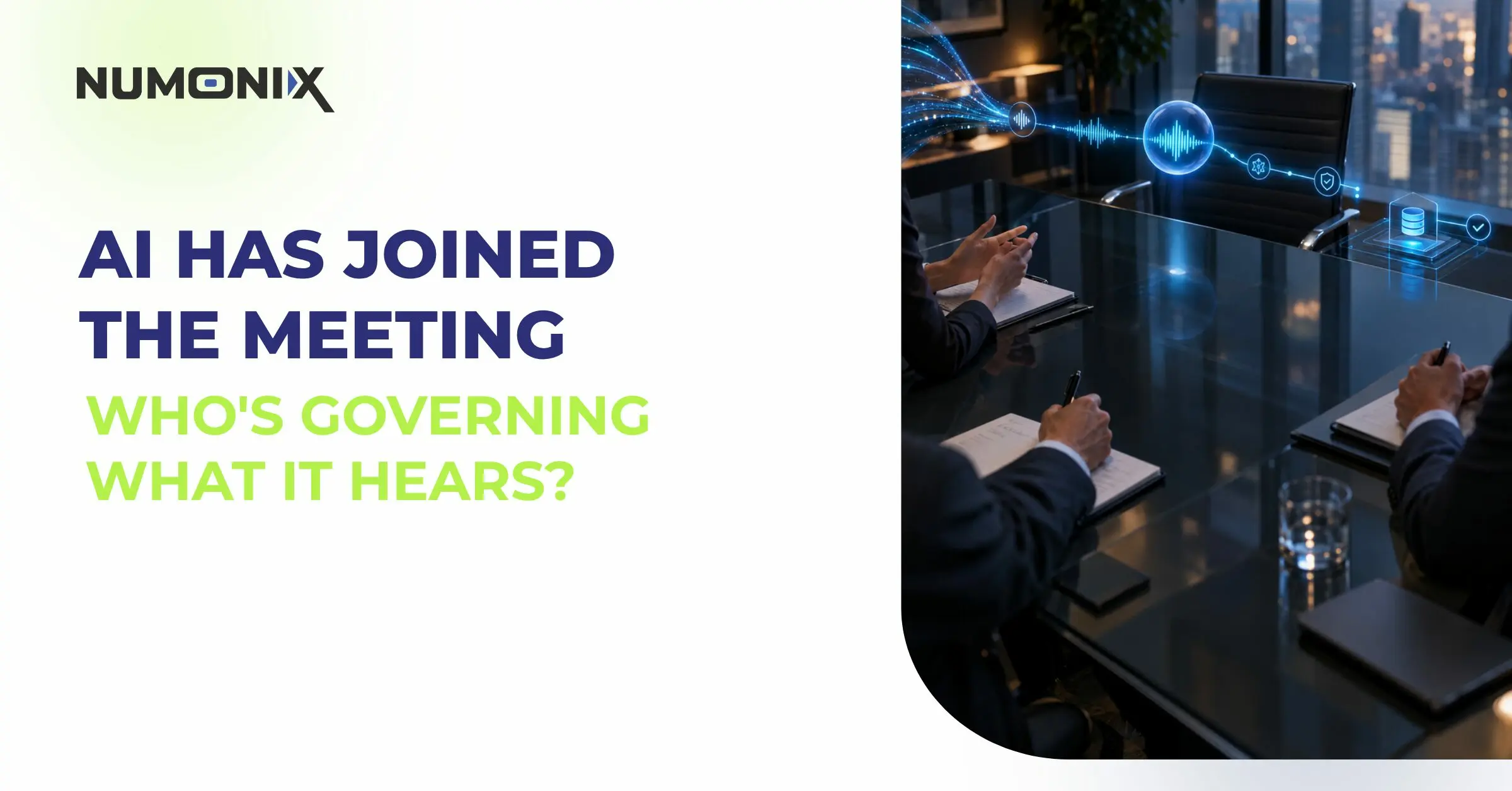
AI has Joined the Meeting. And Suddenly, Compliance Is More Complex.
Compliance call recording has always operated on the rather obvious assumption that its main role was to record the actual participants in a call and capture those interactions in a stable, governed fashion. AI, at least up until this point, has fit pretty comfortably around this simple model. Transcriptions make conversations searchable and summaries help people quickly grasp the essence of a meeting. Actual humans created the source material – the recording simply preserved it.
Microsoft Teams Facilitator has suddenly thrown a technological monkey wrench into our assumptions. Microsoft describes Facilitator as an AI-powered participant that can answer questions using meeting and web content. UC Today recently reported that Facilitator can identify an unresolved factual question during a meeting, then search for information, and introduce an answer into the conversation.
Yes, this all sounds great. But it changes the fundamental assumption for those of us who live and work in the compliance call recording world. AI has suddenly entered the chat. It’s now a potentially active participant in the conversation we’re having and its input is suddenly part of the official record.
The meeting record now has another kind of speaker
Let’s come up with an example to bring this to life. Let’s say a team is discussing a customer issue and someone on the call asks a question nobody can readily answer. Enter Facilitator, who jumps into the fray and comes up with an answer. Everyone on the call then discusses what the AI found and a decision is made based partly on what Facilitator came up with.
The recording can capture the exchange perfectly. We can hear the question, the AI contribution, and the discussion that follows. But the provenance of the conversation has changed. Where did the AI get its answer? Was the source internal or external? Did the participants understand where the answer came from? Importantly, did anyone verify the new information before the group got in line and took action?
These questions matter because the AI contribution has become part of the record itself. It did not simply summarize what happened afterward, which has become the standard expectation up until now. It has joined the conversation and introduced information that could very plausibly change the direction of a project – or a company.
Loyal and faithful readers will recall last week’s post, the Three Artifact Problem, where we discussed how one recorded conversation can produce an original recording, a transcript, and an AI-generated recap. If the recap gets something wrong, the careful reviewer can return to the original recording and determine what people actually said. Sure, it requires a bit of discipline and intellectual rigor, but it’s there (like most things in life) for the taking.
The source of the answer becomes part of the evidence
Suppose an AI recap implies that a customer approved a proposal when the recording shows that the customer only approved it conditionally. Going back to the source material and listening to the original audio can resolve a discrepancy like this. Now, what happens when an AI participant introduces information that causes the team to approve the proposal in the first place. The recording tells us what the AI said. It may not tell us enough about why the AI said it.
The captured recording remains essential because it preserves the original interaction. The evidentiary picture, however, has expanded beyond the audio. Provenance is becoming part of the conversation.
Teams and compliance recording are solving different problems
Microsoft’s direction makes sense when viewed through the job Teams is designed to perform. Meetings contain unanswered questions, and people spend time, often with millions in headcount silently waiting, searching for this missing information.
Facilitator can reduce that downtime by doing the background work into the discussion while it is still happening. Microsoft is making collaboration more productive. This is all a good development.
Compliance recording starts in a different place. A meeting that seems routine today may become important later because a customer challenges a decision, an auditor asks how something was approved, or an investigation needs to reconstruct the sequence of events. At that point, the organization needs to understand both the conversation and the information that influenced the people involved.
This distinction matters hugely because Microsoft and Numonix are approaching the same interaction with radically differing philosophies. Microsoft is expanding what AI can contribute to the conversation. At Numonix, we are concerned with preserving enough context to understand that conversation later. Yes, these can coexist, but AI participation makes the relationship between them much more important.
The provenance problem
This is where compliance-caliber recording starts to require a more active human element. IXCloud provides the governed foundation around the interaction through policy-driven recording, centralized encrypted storage, controlled access, retention, legal hold, integrity controls, auditing, search, and retrieval. All of this helps preserve the source conversation so a reviewer can review it when circumstances require a closer look.
The emerging challenge is connecting that governed interaction with the expanding context around it. As AI participants suddenly enter the conversation to research information and introduce answers on the fly, organizations will need to understand the relationship between the recorded conversation and the information that shaped it. The human element that keeps our ever-expanding systems in check suddenly becomes the ultimate arbiter in whether an investigated conversation concluded with our team saying “yes” or whether the AI said it first.
In other words, how the conversation and its decisions were made may require another layer of understanding.
The birth of decision reconstruction
We can all agree, I hope, that AI and its various applications have made collaboration platforms more useful.
Better provenance gives organizations a way to preserve those productivity gains without losing the ability to understand how consequential decisions were made later. An investigator can distinguish an employee statement from an AI contribution and examine the context around both. Compliance, IT, and AI-governance teams gain a clearer basis for reconstructing how information moved through the interaction and influenced what happened next.
Compliance call recording has always been about preserving what the people in the room said. AI is changing the definition of a “participant” and, with it, the information that may need to survive the meeting. It’s the people around compliance recording – adminstrators, auditors, and others in the compliance space – will have to comprehend this potentially new world of preserving interactions while still giving organizations enough context to understand where the information that shaped it came from.
Frequently Asked Questions
How does AI change the role of compliance recording in Microsoft Teams meetings?
Compliance recording has traditionally focused on preserving what human participants said. AI participants such as Microsoft Teams Facilitator can introduce information into a live meeting, which means organizations may also need to understand where that information came from and how it influenced the discussion or resulting decision.
What is Microsoft Teams Facilitator?
Microsoft describes Facilitator as an AI-powered participant that can support meetings using meeting and web content. UC Today reported in September 2026 that Facilitator can identify unresolved factual questions, search for relevant information, and introduce an answer into the meeting.
Why does provenance matter when AI participates in a meeting?
A recording can preserve what an AI participant said, but that may not explain why it supplied the information. Provenance can help an authorized reviewer understand the source of the information, the context in which it entered the conversation, and how participants used it when making a decision.
Does this mean traditional call and meeting recordings are no longer sufficient?
The recording remains essential because it preserves the interaction. The emerging issue is whether consequential AI-assisted conversations will require additional context around the information introduced by AI. Requirements will vary according to the organization, use case, applicable regulations, and internal policies.
How does IXCloud address this issue?
IXCloud provides a compliance-caliber foundation for recorded interactions through capabilities including policy-driven recording, centralized encrypted storage, controlled access, retention, legal hold, integrity controls, auditing, search, and retrieval. These capabilities support governance of the source conversation. They do not currently imply that IXCloud captures every provenance element associated with every AI participant.
What is decision reconstruction?
Decision reconstruction describes the ability to look back at a consequential interaction and understand how a decision developed. As AI participates more actively in meetings, that may include distinguishing human statements from AI contributions and understanding the information that influenced the participants.