Why the quality of conversational intelligence depends on what gets captured before AI ever sees the transcript.
I have yet to find a business process that doesn’t benefit from tracing its roots back to the very beginning. Whether you’re attaching yourself to a purchase order and understanding the entire flow from beginning of the sale through fulfillment through delivery and ultimately into the hands of a customer or whether you’re simply understanding how an AI application handles a captured interaction, going back to the absolute beginning is often how you debug a problem before it becomes a problem.
When we talk about interaction capture – whether for regulatory compliance or feeding the AI intake layer – it’s just too easy to start at the model level. The problem that we face in real life is that for any AI system that depends on spoken interactions, the quality of the input is dependent on how accurately the quality of the capture is in the first place. Intelligibility, therefore, really is the foundation upon which we need to build.
Insights begin with intelligibility
If you thought that this part of the chain was a commodity and that the audio capture-to-transcription process is basically the same, you could be forgiven. We would disagree though. When your website’s home page literally says the words “Obsessed with Call Recording,” you have to believe that we take this more seriously than most. How a conversation is captured matters tremendously, because intelligibility is not just a convenience – it impacts audit risk in a compliance setting and certainly affects the quality of your insights in an AI intake layer conversation.
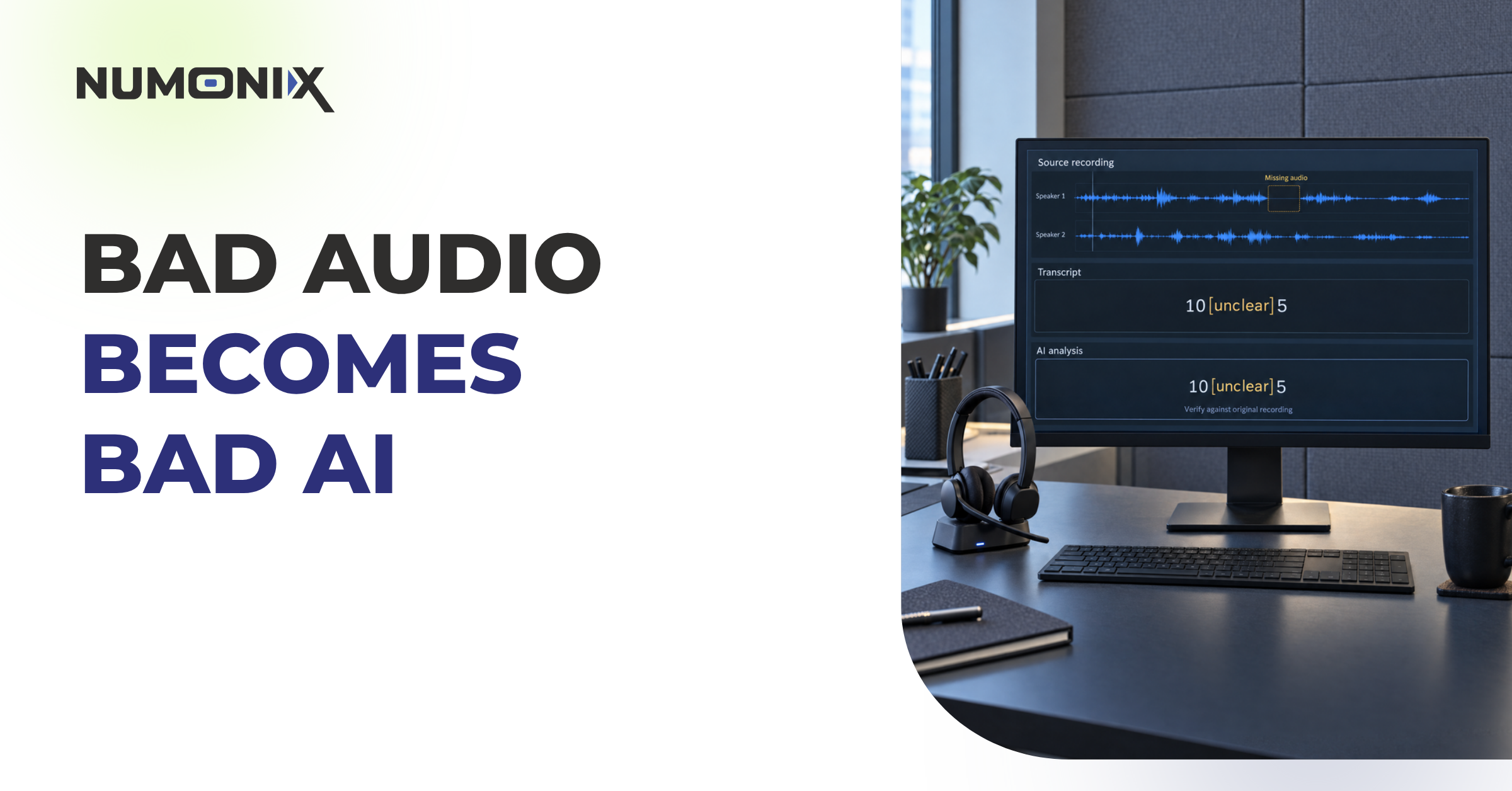
An incomplete number, a missing speaker, distorted audio, or a conversation that was never captured correctly all matters, because once that transcript becomes input for search, summaries, sentiment analysis, retrieval, or an AI agent, the original capture problem can travel downstream.
This creates a sequence that matters as enterprises put more conversational information to work:
Capture fidelity → transcript accuracy → governed conversational intelligence → AI performance.
One financial-services customer described why this distinction became important enough to change recording providers:
“… call quality wasn’t a one-off problem… we logged quite a few support tickets. If a trader said something like ‘1005,’ part of it would be cut off. We would trace our network and check the Teams logs, but our previous recording partner would tell us everything was fine on their side. After dealing with that for years, we decided it was time to switch.”
— Infrastructure leader at a financial-services firm
For a regulated trading conversation, part of a number disappearing is a bit more serious than a garden variety inconvenience. Any given recording is potentially evidence – you just don’t get to pick which ones. And increasingly, as we’ve written in the past few months, it is also the source from which conversational intelligence is created.
Being “Obsessed with Call Recording”
This is why IXCloud treats audio capture as a DNA-level engineering obsession rather than a check-the-box commodity function. The platform supports multiple recording formats and compression options, including GSM, A-law, μ-law, and PCM, with 8,000 Hz and 16,000 Hz sampling. Depending on the integration, recordings can be captured in mono or stereo, with stereo separating RX and TX audio streams. Tenant and group recording profiles allow organizations to apply different configurations based on requirements, including higher-fidelity or stereo configurations for transcription-intensive use cases.
IXCloud also supports capture across Microsoft Teams calls and meetings and other communications environments, with policy-based recording and controlled recording profiles helping determine which interactions enter the governed record.
This obsession is validated by more than a few customers who have told us, as the above vignette shows, that our audio quality is a major decision factor in their buying decisions.
From audio to conversational intelligence
Once captured, audio can be transcribed, with IXCloud supporting speaker separation, multiple transcription engines, and more than 90 languages. The transcript can then support summarization, sentiment analysis, PII redaction, search, analytics, and export to external AI environments.
This is where the AI Intake Layer begins to take shape. It is not simply a pipeline that sends transcripts to a model. It is the controlled process through which conversations become usable enterprise intelligence.
The original recording remains important because the transcript is a representation of the conversation, not the conversation itself. When an AI-generated summary, search result, or analytic conclusion looks questionable, organizations need a route back through the chain: from the AI output to the transcript and ultimately to the original interaction.
That requirement becomes even clearer when recording availability itself fails. A telephony and unified-communications engineer at another wealth-management firm described the experience with their former provider:
“Our previous recording partner had become quite problematic. One of the services would often be down or inaccessible. Recordings wouldn’t play, playback wouldn’t work, or there would be no audio. We kept complaining about it. It was expensive, problematic, and sometimes recordings were missing. In financial services, if you’re not recorded, you’re not allowed to give information to a client.”
— Telephony and unified-communications engineer
A recording that cannot be found or played has no evidentiary value – which is an audit risk, as you can imagine. It also has no intelligence value.
That is why capture cannot be separated from governance. IXCloud combines the recording with controls around playback permissions, retention, legal hold, encryption, digital signatures, access histories, and chain of custody. Metadata-rich audio exports preserve additional context around the interaction. These capabilities do not improve speech recognition directly. They help ensure that the source remains available, controlled, traceable, and capable of being checked against what downstream systems produce.
As enterprises invest in copilots, agents, analytics, and conversational AI, the quality discussion needs to move upstream. The AI Intake Layer does not begin when a model receives a prompt. For spoken interactions, it begins when the conversation is captured.
Compliance taught enterprises to preserve conversations as defensible records. AI gives those same conversations another role as governed intelligence. Both depend on getting the source right.
PS: I would be utterly remiss if I didn’t mention that upstream audio interaction capture quality is directly impacted by the quality of your headset – the part of the equation that happens before the interaction is recorded. I can’t help myself. Two decades in the headset business doesn’t just vanish from consciousness. My Jabra Evolve 65 Flex headset is sitting on my desk while my Logitech Zone 2 Wireless is charging. I’ve got a Poly Blackwire corded headset here somewhere and I’m staring at my Studio 15 on top of my monitor. Your input device matters, too.
FAQ
Why does audio quality matter to AI?
Speech-derived AI depends on the transcript it receives. If the original recording contains missing audio, distortion, crosstalk, or unclear speaker separation, those problems can affect transcription and then carry into search, summaries, analytics, retrieval, and other AI-generated outputs.
Does better audio guarantee better AI results?
No. Audio quality is one upstream factor. Transcription models, terminology, accents, speaker attribution, retrieval, grounding, prompts, permissions, and model behavior also affect the result. High-quality capture removes one important and preventable source of error.
Why keep the original recording if AI primarily uses the transcript?
The recording preserves what was actually captured. If a transcript, summary, or AI-generated conclusion is questioned, the original audio provides a source against which the derived information can be checked. This is particularly important when conversations also serve as regulatory, legal, or operational evidence.
How does IXCloud support high-quality audio capture?
IXCloud supports multiple recording formats and compression options, including GSM, A-law, μ-law, and PCM; 8,000 Hz and 16,000 Hz sampling; and mono or stereo recording depending on the integration. Stereo configurations can separate RX and TX audio streams, while tenant and group recording profiles allow organizations to configure capture according to different requirements, including transcription-intensive use cases.
What is the AI Intake Layer?
The AI Intake Layer is the governed process through which enterprise conversations are captured, transformed into usable conversational intelligence, controlled according to organizational requirements, and made available to approved AI systems and applications. For spoken interactions, that process begins with the quality and completeness of the original capture.
How do compliance recording and AI readiness connect?
Both depend on preserving a trustworthy source conversation. Compliance requires organizations to retain interactions as defensible evidence. AI can use those same interactions as conversational intelligence for search, summaries, analytics, retrieval, and agents. The requirements are not identical, but they share an important foundation: the conversation must first be captured reliably.