The AI Intake Layer Is Showing Up in Customer Conversations
This market evolution in modern UC communications and enterprise-level call recording from a purely “compliance-driven” model to now including the use of voice call transcripts to feed the AI intake layer is more than just theory. Yes, we’ve been writing about it and citing a lot of Microsoft and OpenAI press and research, and while that’s all quite interesting from a cocktail party standpoint, the reality of a market evolution can be acknowledged when someone other than us starts talking about it – customers being the best example.
This is happening at a dramatically accelerating rate and is evidenced by live conversations we’re having with customers.
Just ask Andy Whiteside, our VP of Sales. He sees the change directly in current sales conversations.
“Close to half of the new customer conversations I’m seeing are not compliance requirements. They want to record the call, take the transcript, and add it into their service platform.”
That’s something worth noting. It’s a meaningful change in what customers expect from call recording.
Buyers want the knowledge inside the call
One recent conversation involved a B2B service enterprise whose employees regularly discuss work and commercial commitments with customers. Recording provided an obvious evidentiary benefit when questions arose later about what had been agreed, but company leadership also saw a lot of value in thinking about what could be learned from the conversations themselves.
“They wanted to see what people were saying, they wanted to pick out phrases and words, and search what was happening on those calls.”
We see this opportunity for a single recording to serve two purposes – sure, it preserves an authoritative record of the interaction, but the transcript from the call makes the knowledge inside that interaction available for authorized search and analysis.
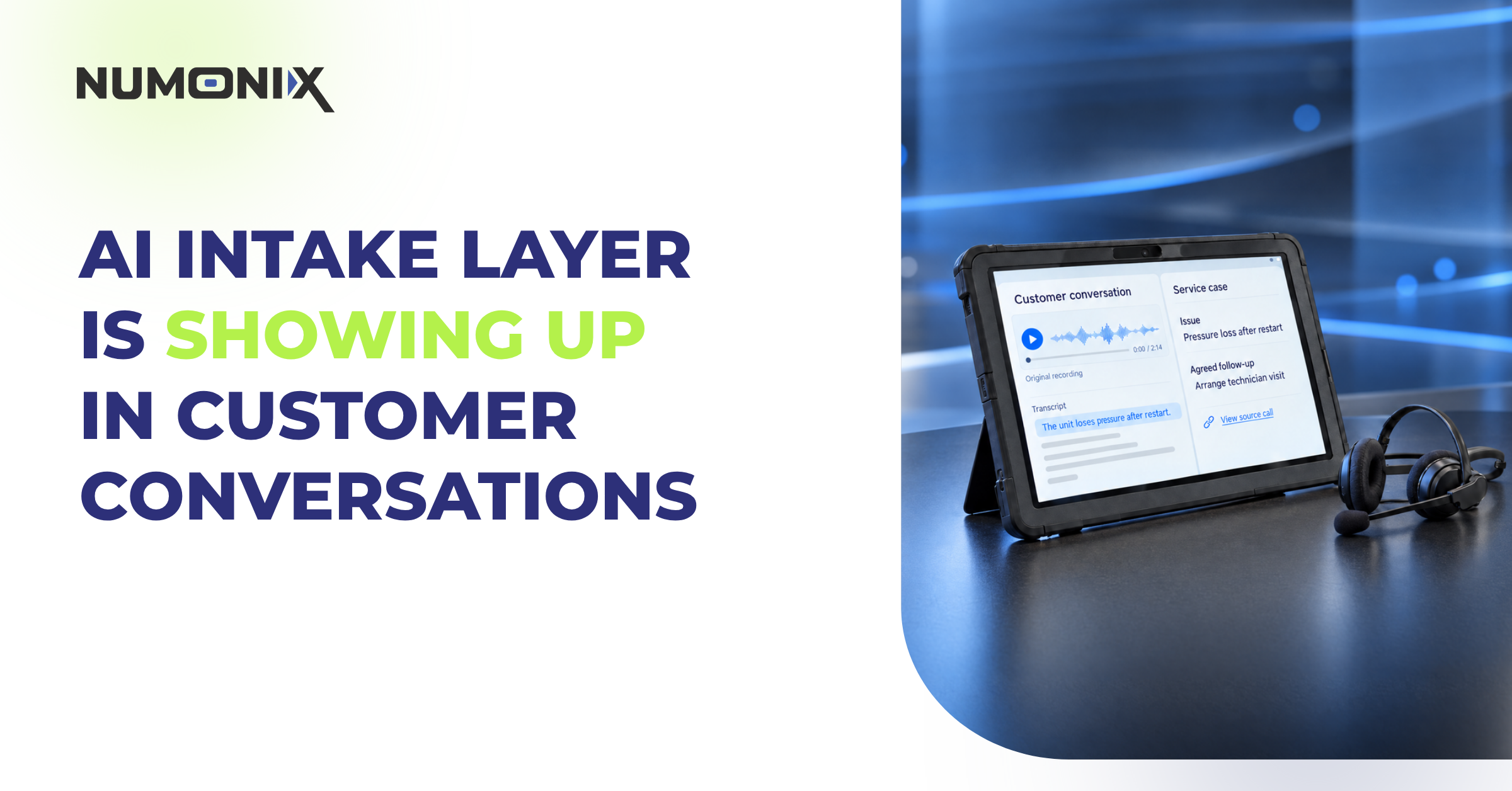
That’s the heart and soul of the entire AI Intake Layer concept. The value is no longer confined to retrieving a recording when something goes wrong. The conversation itself becomes usable enterprise data.
The request is moving from recording to interrogation
Andy described another prospect conversation with both internal support and outbound team interest. Once again, it wasn’t compliance driving the conversation.
Management wanted to understand what their field sellers were discussing with customers. What does the sales guy actually say? What is covered – and what isn’t? What objections are coming up? Were the top “hot topics” brought up frequently?
“It wasn’t a compliance requirement. They wanted to know what people were talking about, what the pitch looked like, and whether the right points were covered.”
Andy’s summary of what he is hearing is simple:
“More and more, this is what we’re getting.”
This matters because calls and meetings contain information that often disappears after the interaction ends. Customer objections, explanations, commitments, recurring problems, product feedback, and operational knowledge may never make it into a CRM field or formal document.
AI gives enterprises a practical way to work with that information at scale, but only if the underlying conversations have been captured and made usable in the first place.
Owning the AI Intake Layer
This is where call recording begins to take on a larger role.
IXCloud can provide a governed environment for policy-based capture, search, playback, permissions, retention, legal hold, audit, sharing, and selective AI-assisted analysis. TRAAS provides another model, capturing Microsoft Teams interactions and delivering the resulting data into customer-controlled applications and workflows.
Neither approach means every conversation should automatically become AI input. We have argued separately that capture, retention, access, and AI processing are different governance decisions. That distinction becomes more important, not less, as conversational data becomes more valuable. The opportunity is to preserve the knowledge while maintaining control over how it is used.
Andy put the business value more directly:
“You can make business decisions from real live content. For me, that’s the big opportunity.”
That may be the clearest evidence yet of where call recording is heading.
Compliance remains fundamental. But customers are beginning to look beyond the recording as something they keep in case they need it later. They want to search it, question it, learn from it, and connect what was actually said to the systems where work happens next.
The AI Intake Layer is moving from an architectural idea toward a customer requirement.
Frequently Asked Questions
What is the AI Intake Layer?
AI Intake Layer is Numonix’s term for the controlled process through which enterprise conversations are captured, governed, and made available for authorized search, analytics, and AI use. It treats recorded interactions as a source of enterprise knowledge while preserving the controls around how that information is accessed and used.
Why are companies recording calls for reasons beyond compliance?
Numonix is beginning to hear from customers that want to capture conversations so they can search transcripts, understand what customers and employees are discussing, evaluate whether important topics were covered, and move conversational information into other business systems. These are current field observations from Numonix sales conversations, not a market-wide survey.
What makes recorded conversations valuable to AI?
Calls often contain customer objections, requirements, commitments, explanations, product feedback, and operational knowledge that never reaches a CRM field or formal document. Capturing the interaction can preserve that information and make it available for authorized analysis later.
Does owning the AI Intake Layer mean recording and analyzing every conversation?
No. Capture, retention, access, and AI processing are separate governance decisions. An organization may have a reason to preserve a conversation without automatically making it available for AI analysis.
How is this different from traditional call recording?
Traditional call recording has often focused on compliance, quality assurance, dispute resolution, and evidentiary needs. Those purposes remain important, but AI creates an additional opportunity to use governed conversational data as an enterprise knowledge source.
How does IXCloud support the AI Intake Layer?
IXCloud provides policy-based capture, centralized search and playback, permissions, retention, legal hold, audit, sharing, and other controls around recorded communications. Authorized users can also selectively apply AI-assisted capabilities to recordings where appropriate.
Where does TRAAS fit?
TRAAS provides managed Microsoft Teams capture and delivers recording data into customer-controlled applications, storage environments, and downstream workflows. This allows organizations to build their own analytics or AI processes around captured Teams interactions while retaining control over the destination and use of that data.