Governing Microsoft Teams Call Queues in the Age of AI
As Microsoft continues to expand Call Queues, the distinction between convenience recording and compliance-caliber recording is becoming increasingly important. These are two different purposes and two different worlds, in many senses. Further, we’ve written a lot about the impact of AI on call recording and the governance challenges that it introduces. Call Queues is clearly a convenience call recording solution that meets many of the needs of typical non-regulated industries would have.
Yes, the personal productivity case is clear. The governance case becomes more complicated because one conversation now potentially produces three related artifacts, which causes those of us in the compliance world to start getting nervous.
One call becomes three versions of what happened
I’d be overstating the case (slightly, but not always) to say that the three-artifact problem can create a Roshomon-like divergence of opinion on what constitutes the truth, but it’s important to note that once we stray from the original audio recording, the first artifact, we now rely on digitally second-hand, or worse, extractions. (I’d like to note that this is likely the only Kurosawa reference any of us in the Teams ecosystem will get today, but it’s worth it to fit these in where possible).
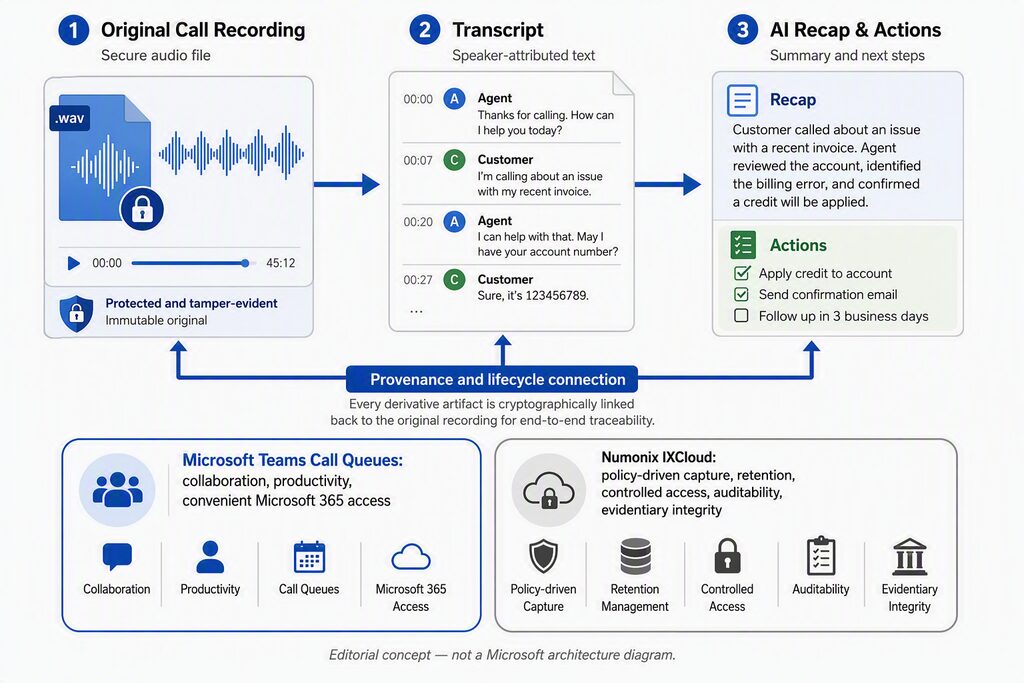
The second artifact is the transcript. It converts speech into searchable, machine-readable text and gives AI something it can process. The transcript remains a representation of the call rather than the call itself. We’ve both read transcripts. We know that things get garbled, cross talk blows up whole sections, and some accents are harder to capture than others. So the quality of this second artifact can swing in amplitude wildly. It won’t always, but it can. And in a compliance sense, that’s trouble.
Now we come to the third artifact, the AI-generated recap. It selects what appears important, compresses the discussion, and turns parts of it into notes, key points, or recommended actions. Microsoft describes intelligent recap as a productivity feature that helps users save time on follow-up. Its documentation also notes that AI-generated recap content can contain inaccuracies in some recap formats. We’ve all seen these recaps, as well. They’re often very useful and occasionally contain off-topic conversations that turn into action items, comments not meant for the call organizer’s ears before or after the organizer joins or leaves the call, etc. Your results may vary.
These three artifacts support different jobs. A representative may need the recap to continue helping the customer. A supervisor may use the transcript to locate part of a discussion. A compliance officer, investigator, or attorney may need the original recording to determine what actually occurred.
The governance problem appears when the organization controls the recording carefully but allows the transcript, recap, or follow-up action to move through the business without preserving its connection to the source or to not have the safeguards in place to ensure that what’s in the second and third artifacts doesn’t fall into the wrong hands.
Here’s how we see the flow:
Microsoft and Numonix begin with different jobs to be done
Let’s talk for a moment about differences in philosophy and design. Microsoft Call Queues addresses the operational work surrounding shared customer calls. Microsoft gives administrators per-queue recording and transcription controls, configurable announcements, SharePoint storage, and permissions for authorized users and representatives. Native recording therefore includes meaningful administrative and access controls. For documentation, training, service continuity, and routine operational review, it may be entirely appropriate.
The Queues app extends that operational philosophy. It brings call history, customer follow-up, recording access, reporting, and AI assistance into the Teams environment where representatives already work. Microsoft optimizes the experience around collaboration, productivity, and convenient access within Microsoft 365.
Numonix and our IXCloud compliance-caliber call recording platform begins with a different assumption: the conversation may have to survive as evidence.
Any routine call that comes in today may suddenly become the pivot point in a customer conflict, an audit, or a lawsuit. At some point, in other words, convenience matters less than the organization’s no-nonsense ability to retrieve the recording, control who can hear it, demonstrate how long it was retained, and establish whether it remained intact.
That assumption shapes the IXCloud architecture. IXCloud supports policy-based capture, centralized encrypted storage, role-based access, custom retention profiles, legal hold, digital signatures, playback permissions, and documented access trails. These controls support an organization’s compliance and governance requirements. They do not make compliance automatic or replace the organization’s own policies and legal obligations, but they support the organization’s efforts to a significant degree.
Microsoft’s own documentation recognizes the distinction between native recording and compliance recording. Microsoft describes third-party compliance recording as policy-based, company-owned capture for processing and retention under corporate or regulatory policies. Microsoft also maintains a certification program for those partner solutions and lists Numonix among its certified compliance-recording providers.
The difference therefore does not depend on an argument that Microsoft Call Queues lacks governance. It depends on the purpose the recording must serve.
Microsoft Call Queues helps people use the conversation. IXCloud helps the organization preserve and govern the conversation when the record itself matters.
AI raises the cost of choosing the wrong recording model
Before intelligent recap, an organization could treat a Call Queue recording as a useful operational file and decide that SharePoint storage and Queues app access was all they needed.
But AI, for all of its wonderful uses, creates downstream consequences. A recap can shape a representative’s next conversation. A recommended task can hijack a coworker’s workflow. A compressed statement can become the version of events that colleagues remember, even when the original call contained more qualification or uncertainty.
The Numonix point of view is that the original conversation should remain the authoritative governed source. The first artifact becomes the single source artifact of truth and should be treated that way. The transcript and AI-generated recap remain derivatives. They should retain enough provenance for an authorized reviewer to move back through the chain and understand where an interpretation or action originated. Once an organization aligns behind this idea, it kills any notion that an AI-generated note has the same legal or records status as the recording.
Where companies feed Teams interaction data into their own AI or analytics environments, TRAAS adds a related infrastructure option. TRAAS provides managed, Microsoft-certified capture and delivers recording data and metadata into customer-selected storage or applications. Its role in this discussion remains upstream: creating a controlled capture and delivery path before another system begins interpreting the conversation.
Keep productivity connected to proof
Organizations can embrace Microsoft’s collaboration and AI improvements while maintaining a compliance-caliber source of truth.
The immediate benefit is faster work. Representatives can use recaps and suggested actions without replaying every call. The longer-term benefit comes from keeping those outputs connected to a governed recording. Investigators can reconstruct what happened. Compliance and records teams can apply retention and access practices to the authoritative source. IT and AI teams can build workflows without losing sight of where the underlying information originated.
Microsoft is making customer conversations easier to use. Numonix focuses on making the original interaction durable, controlled, immutable, and defensible when the worst case scenario appears on your calendar.
Frequently Asked Questions
What is the “three artifact problem” in Microsoft Teams Call Queues?
A recorded Call Queue interaction can now produce three related artifacts: the original call recording, a transcript, and an AI-generated recap with notes or recommended actions. Each serves a different purpose. The governance challenge is maintaining a clear relationship between the authoritative source conversation and the derivative information created from it.
Does Microsoft Teams Call Queue recording include governance controls?
Yes. Microsoft documents administrative recording and transcription controls, SharePoint storage, recording announcements, and access for authorized users and representatives. Native Call Queue recording can be appropriate for documentation, training, service continuity, and operational review. Organizations with requirements for policy-driven capture, retention, legal hold, evidentiary integrity, or detailed auditability should evaluate whether compliance-caliber recording better fits the intended use.
Why shouldn’t an AI-generated recap replace the original recording?
An AI recap interprets and compresses the conversation. It can help employees understand what happened and determine what to do next, but Microsoft acknowledges that AI-generated recap content can contain inaccuracies in some recap formats. Preserving the original recording gives authorized reviewers a source against which transcripts, summaries, and resulting actions can be evaluated.
How is IXCloud different from native Microsoft Call Queue recording?
Microsoft Call Queues is designed around collaboration, productivity, and convenient access to customer interactions within Microsoft 365. IXCloud approaches recording from a compliance-caliber perspective, supporting policy-based capture, centralized encrypted storage, role-based access, retention profiles, legal hold, digital signatures, playback controls, and documented access trails. The appropriate architecture depends on what the organization expects the recording to become after the call.
Does using IXCloud automatically make an organization compliant?
No. IXCloud provides controls that support compliance and governance requirements. Compliance ultimately depends on applicable regulations, organizational policies, configuration, operating procedures, and how the organization manages recorded communications.
How does AI change the recording decision?
AI increases the number of artifacts and actions that can originate from a conversation. A transcript can feed a recap, the recap can produce a recommended task, and that task can influence another business process. Organizations therefore need to consider provenance, retention, access, and traceability across the entire chain rather than evaluating recording solely as a storage decision.