When the Summary Outlives the Source
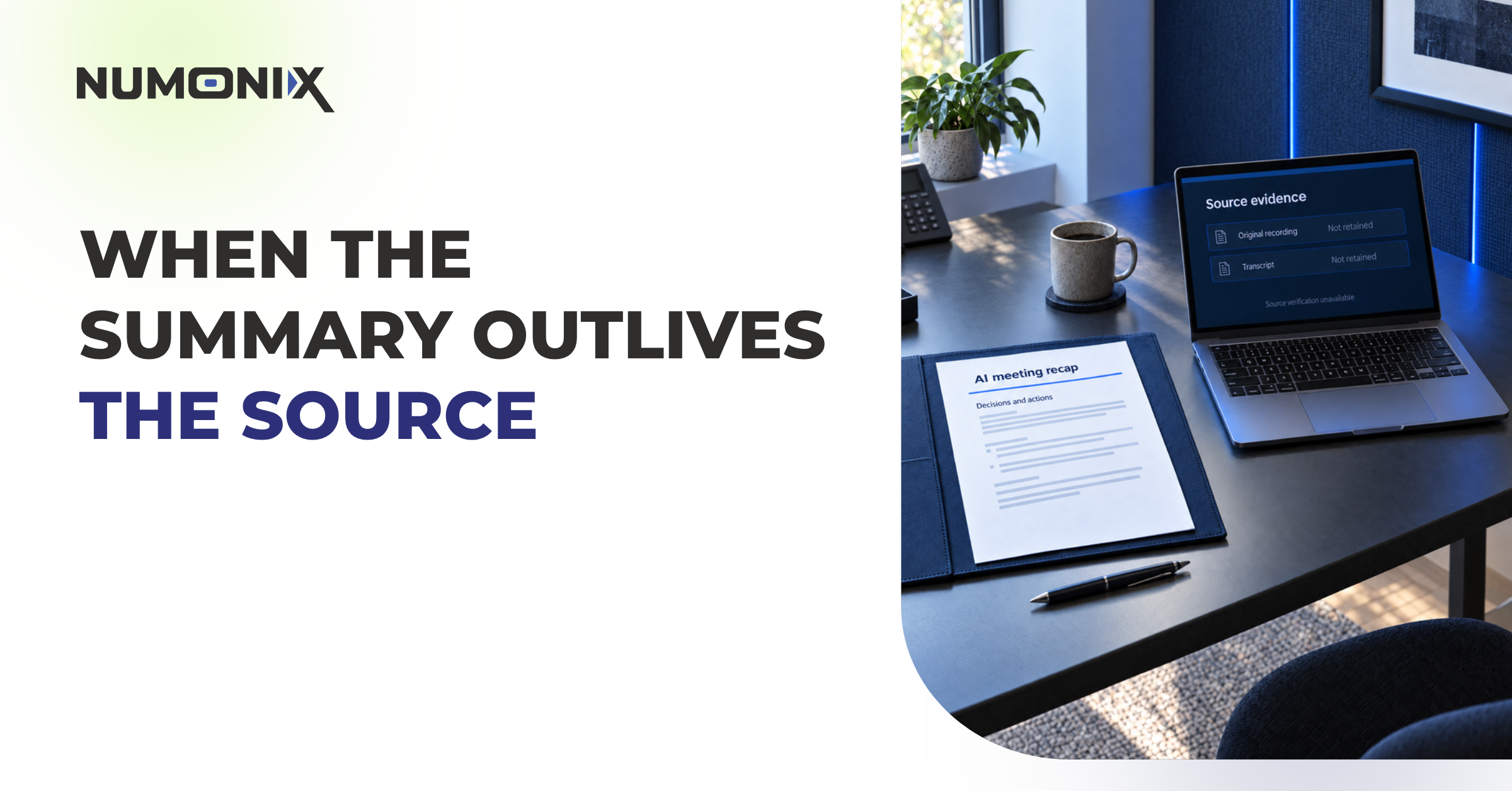
Microsoft Teams can now preserve an AI-generated recap without retaining the recording or transcript behind it. This may address a certain class of privacy, but it opens up a whole new can of worms when it comes to governance. Ask yourself an important question here: when an AI derivative becomes an actual business record, can anyone verify it?
Microsoft Teams Has announced that it can now generate an Intelligent Recap for a scheduled meeting without saving the recording or a persistent transcript. Teams processes live meeting audio, produces an AI summary, and stores that summary as a read-only Word document in the organizer’s OneDrive, giving administrators the ability to set retention periods. Microsoft positions the capability for organizations that prohibit recordings or transcripts or need to limit their retention for compliance reasons.
The feature addresses a legitimate problem, as recordings and their transcripts can contain confidential discussions, personal information, intellectual property and material that an organization has no reason to retain indefinitely. Deleting the underlying artifacts may reduce privacy exposure, not to mention save on storage, and the volume of information subject to discovery or records-management requirements.
The real issue begins once the source file is no more.
An AI recap by its very nature will summarize what it believes are the major decisions and inputs by different participants as best it can. But once the recap is all that’s left of the conversation, it becomes the operational record – the source material is no longer available.
The derivative is not the source
A recorded conversation can produce several related artifacts. The original recording preserves the captured interaction. The transcript converts it into a searchable, machine-readable representation. An AI recap compresses that representation into selected points, conclusions and proposed actions.
Those artifacts serve different purposes. As we discussed in The Three Artifact Problem, an employee may use the recap to continue working, a supervisor may search the transcript to locate a passage, and an investigator may return to the recording to determine what was actually said. Each step moves further from the original interaction and adds another layer of processing or interpretation.
The distinction matters because a summary by definition leaves context – and occasionally meaning – out. A summary is meant to remove repetition and irrelevant discussion, but it can also prune out qualifications, misstate who agreed to an action, convert an unresolved question into an apparent conclusion, or give an incidental comment more importance than participants intended.
Retention should follow the derivative’s purpose
A smart recording policy does not require that every interaction be captured and stored for the duration. But good governance needs to begin by asking what a recap is for and what it will become.
If the summary is a convenience used to remind participants what they discussed, deleting the source may be entirely reasonable. The recap itself may also expire after a defined period. Microsoft supports this approach by allowing administrators to configure the retention period for Intelligent Recap documents and by supporting their deletion.
The decision changes when the derivative enters a durable workflow. A recap may be copied into a CRM record, used to document customer consent, cited in a performance review, attached to an investigation or relied upon to supervise regulated activity. The organization should then determine whether the derivative must preserve a relationship to its source, what evidence must remain available, who may review it and how long both artifacts should be retained.
This does not mean every AI summary needs an accompanying recording, as we’ve agreed above. But it does mean that the retention decision should account for the business use of the derivative rather than treating source deletion as the end of the governance discussion.
People trust AI more when its work remains reviewable
There’s an emerging body of trend research digging into this issue of AI and trust. Recent research from Kantar found that consumers were more willing to delegate shopping activities they could understand, inspect, and reverse decisions rather than let AI make purchases independently. Only 28% of respondents were comfortable allowing AI to make a purchase on their behalf.
Pew Research Center found a similar pattern in healthcare. Americans were generally open to AI assisting with administrative and clinical tasks, but the largest shares preferred human review. Acceptance declined as the consequences of the decision increased.
Consumer shopping and healthcare decisions may be different worlds from what we’re discussing, but the common signal is relevant: trust grows when people can examine what AI produced, compare it with an authoritative source, and retain human responsibility for the outcome.
Keep intelligence connected to evidence
The same principle applies as conversations move into enterprise AI. Why Enterprise AI Needs Governed Conversation Inputs describes the controlled progression through which an interaction is captured, made machine-readable, governed and made available to authorized systems. Bad Audio Becomes Bad AI addresses an earlier point in that chain: the quality of downstream intelligence can be constrained by what the system successfully captures in the first place.
IXCloud supports that governed source layer through policy-based recording, configurable retention, legal hold, digital signatures, role-based access, playback permissions and documented access activity. Its Analytics Package can create transcripts, summaries and other post-call analysis while keeping the transcript displayed alongside the underlying audio and applying controls to sensitive information.
These controls do not make an AI recap accurate. They preserve the organization’s ability to investigate how a conclusion was reached.
AI-generated summaries will increasingly become part of ordinary business processes. The governance requirement is not to preserve everything forever. It is to recognize when a convenient derivative has become a consequential record and ensure that policy keeps pace with that change.
Frequently Asked Questions
Is an AI-generated recap evidence?
It can become part of an evidentiary or operational record, depending on how the organization uses it. It remains a derived interpretation of the conversation rather than the original interaction.
Is deleting a meeting transcript inherently risky?
No. Transcript non-retention may support legitimate privacy, compliance and data-minimization objectives. Risk increases when a retained recap influences consequential activity and no source remains available to verify it.
Why does the original recording matter if a transcript exists?
A transcript is a machine-generated representation of speech. The recording allows an authorized reviewer to check wording, speaker attribution, context and sections that may have been transcribed incorrectly or incompletely.
How should retention policy treat AI-generated derivatives?
Policy should consider the derivative’s purpose, where it is stored, how long it remains available, who may access it and whether it enters another system. A recap used as a durable customer, supervisory, audit or decision record may require a different retention approach from an ephemeral meeting aid.
Does an AI summary need to remain connected to a recording in every case?
Not necessarily. The need for a verification path depends on the consequences of relying on the summary, applicable legal and regulatory requirements, and the organization’s own records policy.
How does governed interaction capture support AI use?
Governed capture preserves the source conversation under defined recording, access, retention and integrity controls. Those controls allow authorized reviewers to trace transcripts, summaries and downstream AI outputs back to the interaction from which they originated.